
Source: Art World Database
INTERVIEW WITH ART WORLD DATABASE
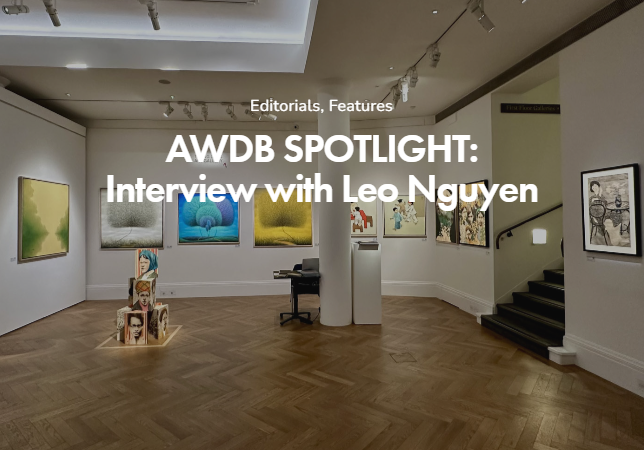
AWDB spoke to Leo Nguyen of Thang Long Art Gallery on the occasion of their presentation at Asian Art in London 2025. Established in Hanoi in 1996, the gallery joined this year’s edition with the exhibition ‘Vietnam – Enchanting Beauty’, hosted by Sotheby’s New Bond Street and showcasing contemporary works by artists such as Hong Viet Dung, Nguyen Thanh Binh, Vu Cong Dien and Ngo Van Sac.
The gallery’s presentation emphasised how post-colonial Vietnam has navigated its history through material innovation and visual calm, a contrast to the frenetic global art market. Rather than focusing on antiquities (as many other galleries at AAL do), Thang Long foregrounds contemporary trajectories and evolving techniques, reflecting the gallery’s mission to extend Vietnam’s voice within international conversations about identity, tradition and modernity.
Could you walk us through what Thang Long showed this year for Asian Art London?
First of all, we were very honoured to be part of the 28th edition of Asian Art in London in 2025. Thang Long Art Gallery held an exhibition titled ‘Vietnam – Enchanting Beauty’ hosted by Sotheby’s at New Bond Street. The exhibition showcased exquisite works from notable Vietnamese contemporary artists, including Hong Viet Dung (1962) from the renowned “Gang of Five”, Nguyen Thanh Binh (1954), Vu Cong Dien (1976) and Ngo Van Sac (1980). Each with their unique style and technique, unveiled a distinct perspective that reflects their deep appreciation for the enchanting beauty of Vietnam.
Their artworks exhibit a unified theme that aspires to depict serene, tranquil landscapes, imbued with a somewhat ethereal and enchanting beauty. Accompanying this are human emotions, rich in affection, with human visages that encapsulate memories, culture, and history. It provides an artistic environment for us to unwind, reflect, and rejuvenate. A distinct aesthetic “silence,” which appears to stand in stark contrast to the modern world beyond, characterised by anxiety, chaos, and transformation.
You showed a lot of contemporary pieces compared to other galleries at AAL, which tend to prioritise more traditional works and antiquities. How do you think that contrast shifts how the event’s audience saw your show? How do you think audiences here in London respond to Vietnamese work in particular?
I believe that contemporary art, particularly Vietnamese contemporary art, presents a fascinating area for exploration, and we aspire to enhance awareness regarding this topic. Specifically, Vietnam is recognised for its tumultuous history, having endured numerous wars in the past, which has resulted in a relatively recent modern and contemporary art history. The establishment of our first formal national college of fine arts dates back to 1925, initiated by the French colonial government. During this period, Vietnamese artists began to experiment with new approaches to traditional mediums, such as lacquer on wood, and watercolour on silk.
In 1986, with the establishment of peace, and Vietnam’s economic opening to the world (the Renovation Period), a new wave of information and creativity emerged within the country. We began to witness the introduction of more modern mediums, including oil on canvas, gouache on rice paper, and subsequently, wood-burning techniques, and various other forms of mixed media.
Moreover, alongside the diverse range of mediums, Vietnamese contemporary artists post-1986 exhibited even greater divergence from Social Realism, which had been the prevailing influence during the initial generation of Indochine artists. Two artists featured in our exhibition, Hong Viet Dung (b.1962) and Nguyen Thanh Binh (b.1954), from the Renovation Period, are notable for their independence from both French influence and the communist era’s alternative to social realism. The rapid industrialisation and economic growth of Vietnam during these years, continuing to the present day, have generated numerous contradictions and disruptions within Vietnamese lifestyles and the chaotic modern society. Both artists appear to have discovered solace in the tranquillity of Buddhism, reminding us that all life is transient.
In subsequent generations, our remaining two artists, Vu Cong Dien (b.1976) and Ngo Van Sac (b.1980), have infused their paintings with even more imagination and fantasy, employing bolder colour palettes and contemporary techniques, such as wood-burning, which we will explore further later.
You spoke on a panel titled ‘Traditions Within Contemporary’. What ideas did you bring into that conversation?
As a gallery, we take pride in our contribution to the preservation and promotion of Vietnamese cultural heritage in the realm of contemporary art. We have consistently supported artists who align with this value. Vietnam is recognised as a rising economic powerhouse in Asia, and amidst the prioritisation of globalisation and economic growth, we believe it is becoming ever more crucial to enhance public awareness regarding the significance of cultural heritage and traditions, ensuring they are not overlooked in the quest for economic advancement.
Ngo Van Sac’s use of wood and pyrography gives his portraits a really tactile, raw quality. Why did you feel his work was important to include in a show about Vietnam’s contemporary art?
Ngo Van Sac is a notable artist who is increasingly recognised in Việt Nam and internationally for his unique take on wood burning art using blowtorches, combined with other media and materials, creating a very contemporary and inclusive artistic viewpoint.
Ngo Van Sac began his journey into the art of painting on wood panels more than a decade ago. Nevertheless, upon reviewing his earlier works, he realised they fell short of his elevated standards and chose to take a daring action. He ignited his former paintings. As he observed the transformation of fire and wood before him, he uncovered the technique of wood-burning.
His portrait paintings depict much more than the human face; they bear witness to culture and history, incorporating details and motifs from traditional scripts and costumes and ancient architecture and landscapes that have been immortalised in the Vietnamese soul, calling to us like echoes of our origin and from the past. The artworks, therefore, become so much more than just something pretty to look at; they carry within them the depth of meaning and associated symbolism.
The burnt wood grains are used to convey the passage of time, like a cloud of nostalgia or the fog of oblivion, blurring the line between human fate and nature and the past and the present, leaving us with unanswered questions. Who am I? Where did I come from? Where am I going?
Ngo Van Sac endeavours to safeguard Vietnamese cultural heritage using his own approach. He utilised architectural elements from traditional Vietnamese structures, frequently seen in temples, as inspiration for his artwork. Sac also integrated ancient Vietnamese script (Han-Nom) into his creations. During the Land Reform in North Vietnam during the 1950s, numerous old texts written in Han-Nom were compelled to be destroyed. Presently, these Han-Nom texts are rarely observed. Interestingly, Ngo Van Sac’s family succeeded in preserving several books authored by his grandfather, who composed poetry. These pages of poetry are now meticulously chosen by Sac and affixed to his artwork, serving as a repository of a nearly lost body of Vietnamese writing.
What kind of opportunities do you think events like AAL open up for Vietnamese artists abroad?
This exhibition marked our second consecutive year of participation in Asian Art in London. This esteemed platform provides an exceptional opportunity to present Asian art in a comprehensive manner. It is relatively rare when Vietnamese contemporary art can be exhibited on an international stage alongside prominent art forms such as Chinese, Japanese, Indian, Islamic, and Korean. Furthermore, visitors, art enthusiasts, and collectors traveled from across the globe to attend over twenty exhibitions and auctions dedicated to Asian Art, all occurring last week in Mayfair. At Thang Long Art Gallery, we regard it as our responsibility to advance Vietnamese contemporary art on significant international stages like Asian Art in London.
Thang Long’s presentation for AAL, ‘Vietnam – Enchanting Beauty’, was on view at Sotheby’s, London, United Kingdom, until 5 November. For more exhibitions for Thang Long Art Gallery, please click here, and to follow AAL, click here.
INTERVIEW COURTESY OF ART WORLD DATABASE AND LEO NGUYEN, NOVEMBER 2025